
Introduction
Choosing the right fire alarm system is one of the most important decisions businesses can make in 2026. With stricter UAE Civil Defense regulations, increasing commercial developments, and growing fire safety awareness, companies across Abu Dhabi, Dubai, and the UAE must invest in reliable fire detection systems that ensure fast emergency response and long-term compliance.
When selecting a fire alarm system, most businesses face one important question: Conventional vs Addressable Fire Alarm Systems — which one is better?
Both systems are widely used across commercial buildings, warehouses, industrial facilities, hotels, hospitals, and residential towers. However, each system works differently and is designed for specific building requirements, risk levels, and budgets.
Understanding the differences between Conventional vs Addressable Fire Alarm Systems helps businesses choose the right solution for safety, operational efficiency, and future scalability.
This guide explains how both systems work, their advantages, limitations, ideal applications, and how to determine the best fire alarm system for your UAE business in 2026.
Why Fire Alarm Systems Are Essential in UAE
Fire alarm systems are critical components of any modern fire protection strategy. Their primary purpose is to detect fire hazards early and alert occupants before the situation becomes dangerous.
In the UAE, fire alarm systems are mandatory for most:
- Commercial buildings
- Warehouses
- Factories
- Hotels
- Hospitals
- Residential towers
- Shopping malls
- Educational institutions
A properly installed fire alarm system helps:
- Protect lives
- Minimize property damage
- Improve emergency response
- Ensure Civil Defense compliance
- Reduce operational downtime
- Support evacuation procedures
As buildings become smarter and larger in 2026, choosing the right alarm system becomes even more important.
What Are Conventional Fire Alarm Systems?
Conventional fire alarm systems are one of the oldest and most commonly used fire detection technologies.
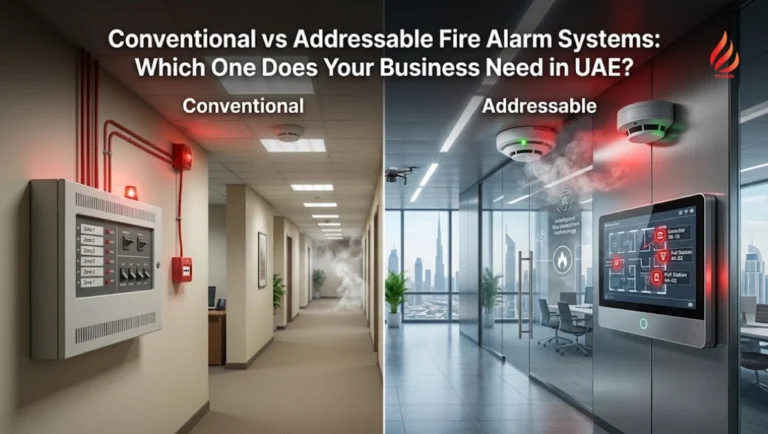
These systems divide a building into multiple zones. Each zone contains detectors, manual call points, and alarm devices connected to a central fire alarm control panel.
When a detector is activated, the panel identifies the affected zone but does not identify the exact device location.
For example:
- Zone 1 = Ground Floor
- Zone 2 = Warehouse Area
- Zone 3 = Office Section
If an alarm activates in Zone 2, responders know the fire is somewhere within that zone, but not the exact detector location.
Advantages of Conventional Fire Alarm Systems
Cost-Effective Installation
Conventional systems are generally more affordable for smaller buildings and businesses with limited budgets.
Simple Design & Operation
These systems are easy to install, operate, and maintain.
Suitable for Small Buildings
Conventional systems work well for:
- Small offices
- Retail stores
- Small warehouses
- Residential villas
- Small commercial buildings
Reliable Basic Protection
For low-risk environments, conventional systems provide effective fire detection and alarm functionality.
Limitations of Conventional Fire Alarm Systems
Despite their affordability, conventional systems have several limitations.
Limited Detection Accuracy
The system only identifies the affected zone, not the exact device location.
This can delay emergency response during large-scale incidents.
More Wiring Required
Each zone requires separate wiring, increasing installation complexity in larger buildings.
Difficult Expansion
Adding new zones or devices can become expensive and complicated over time.
Limited Smart Integration
Traditional conventional systems have fewer smart monitoring and automation features compared to addressable systems.
What Are Addressable Fire Alarm Systems?
Addressable fire alarm systems are more advanced and intelligent fire detection solutions.
Unlike conventional systems, every device connected to the system has its own unique address.
This means the control panel can identify:
- The exact detector activated
- Device location
- System faults
- Maintenance alerts
For example:
“Smoke Detector – Server Room 2 – Activated”
This level of precision significantly improves emergency response times.
Advantages of Addressable Fire Alarm Systems
Exact Fire Location Detection
Addressable systems identify the precise location of the activated device, allowing faster emergency action.
Faster Troubleshooting
The system quickly identifies faulty devices, wiring issues, or maintenance requirements.
Reduced False Alarms
Advanced sensors and intelligent monitoring reduce false alarm incidents.
Easier Expansion
Addressable systems are scalable and easier to expand for growing businesses.
Smart Building Integration
Modern addressable systems integrate with:
- CCTV systems
- Access control systems
- Building management systems
- Emergency evacuation systems
- Smart monitoring platforms
Lower Long-Term Maintenance Costs
Although initial installation may cost more, easier maintenance and diagnostics reduce long-term expenses.
Conventional vs Addressable Fire Alarm Systems: Key Differences
Detection Accuracy
- Conventional: Identifies only the zone
- Addressable: Identifies the exact device location
Installation Cost
- Conventional: Lower initial cost
- Addressable: Higher initial investment
Scalability
- Conventional: Limited expansion flexibility
- Addressable: Highly scalable
Maintenance
- Conventional: More manual troubleshooting
- Addressable: Intelligent diagnostics
Smart Features
- Conventional: Basic alarm functions
- Addressable: Advanced integration & automation
Ideal Building Size
- Conventional: Small properties
- Addressable: Medium to large buildings
Which Fire Alarm System Is Best for UAE Businesses?
The right choice depends on your building size, risk level, operational requirements, and future growth plans.
Conventional Systems Are Best For:
- Small offices
- Small retail stores
- Villas
- Small clinics
- Small warehouses
- Budget-conscious businesses
Addressable Systems Are Best For:
- High-rise buildings
- Large warehouses
- Factories
- Hotels
- Hospitals
- Shopping malls
- Data centers
- Industrial facilities
Conclusion
Understanding the differences between Conventional vs Addressable Fire Alarm Systems is essential for businesses planning fire protection upgrades in 2026.
Conventional systems offer cost-effective protection for smaller buildings, while addressable systems provide advanced monitoring, precise detection, and scalable protection for larger commercial and industrial facilities.
As UAE fire safety regulations continue to evolve, businesses should invest in systems that not only meet current requirements but also support future growth, smart integration, and operational efficiency.
Whether you operate a warehouse, office, factory, hotel, or commercial tower, choosing the right fire alarm system can significantly improve safety, reduce risks, and ensure long-term compliance across your facility.