
Introduction
Fire safety standards are evolving rapidly, and businesses must stay ahead of compliance requirements. In 2026, Suppression System Integrity Testing has become a critical part of fire protection strategies for data centers, industrial facilities, commercial buildings, and high-risk environments.
As fire suppression systems become more advanced, ensuring their effectiveness during real emergencies is essential. Integrity testing verifies whether your suppression system can actually contain and suppress a fire as designed — not just exist on paper.
What Is Suppression System Integrity Testing?
Suppression System Integrity Testing evaluates whether an enclosed space can maintain the required concentration of fire suppression agents during discharge. This is especially important for clean agent systems like FM-200, Novec 1230, and inert gas suppression systems.
The test determines whether the protected room can:
Retain suppression agents long enough
Maintain required concentration levels
Prevent leakage through gaps or structural flaws
Meet fire safety compliance standards
Without proper integrity testing, even a perfectly installed suppression system may fail during an emergency.
Why Suppression System Integrity Testing Matters More in 2026
Fire protection authorities are enforcing stricter compliance standards globally. In 2026, fire suppression effectiveness is no longer assumed — it must be proven.
Key reasons integrity testing is essential today:
1. Stricter Compliance Requirements
Regulatory bodies and civil defense authorities require documented integrity test results.
2. Advanced Fire Suppression Systems
Modern suppression systems rely on precise concentration levels. Minor leaks can cause major failures.
3. Increased High-Risk Facilities
Data centers, server rooms, and energy facilities require zero-failure fire protection.
4. Insurance and Liability Factors
Insurance providers now demand documented Suppression System Integrity Testing reports.
How Suppression System Integrity Testing Works
Integrity testing is typically conducted using specialized equipment and non-destructive methods.
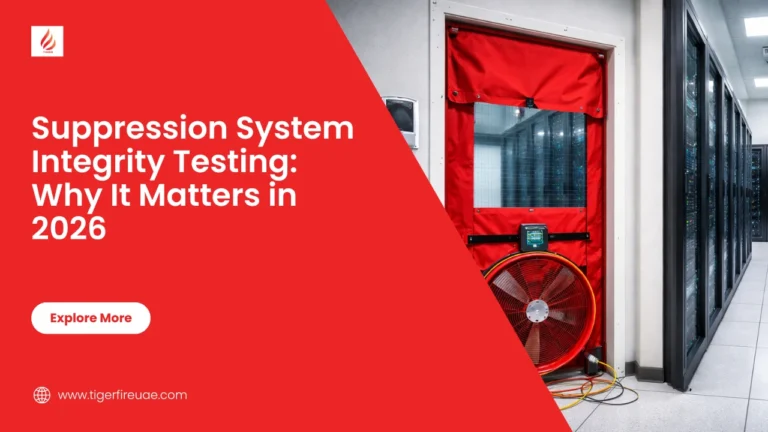
1. Door Fan Testing (Room Integrity Test)
This is the most common method. A calibrated fan is mounted on a doorway to measure air leakage rates.
The process includes:
Pressurizing and depressurizing the room
Measuring leakage points
Calculating agent retention time
Generating compliance reports
This test helps identify whether the enclosure can hold suppression gases long enough to extinguish a fire.
2. Leakage Detection and Analysis
Technicians identify leakage points such as:
Cable penetrations
Ceiling voids
HVAC ducts
Door seals
Structural joints
Even small gaps can compromise suppression effectiveness.
3. Retention Time Calculation
Fire suppression systems require a minimum retention time (often 10 minutes or more). Integrity testing calculates whether the room can maintain the required concentration during this period.
If retention time falls short, corrective actions are recommended.
Systems That Require Suppression System Integrity Testing
Integrity testing is essential for environments using gaseous suppression systems, including:
Data centers and server rooms
Control rooms
Telecom facilities
Electrical substations
Museums and archives
Laboratories
Oil and gas control facilities
These spaces rely heavily on clean agent suppression systems where enclosure integrity is critical.
Common Issues Found During Integrity Testing
Suppression System Integrity Testing often reveals hidden vulnerabilities.
Common problems include:
Unsealed cable openings
Leaky door frames
Poorly sealed ceiling tiles
HVAC leakage paths
Structural cracks
Aging construction materials
Identifying these issues early prevents catastrophic failures.
Consequences of Skipping Integrity Testing
Ignoring Suppression System Integrity Testing can have serious consequences.
System Failure During Fire
Suppression gas may escape before extinguishing the fire.
Compliance Violations
Regulatory audits may result in penalties or shutdowns.
Insurance Claim Rejection
Lack of testing documentation can invalidate claims.
Safety Risks
Fire spread due to ineffective suppression puts lives and assets at risk.
In 2026, skipping integrity testing is a major compliance risk.
Benefits of Regular Suppression System Integrity Testing
Routine testing provides multiple advantages.
Ensures Fire Suppression Effectiveness
Verifies real-world performance of suppression systems.
Supports Compliance
Helps meet local and international fire safety regulations.
Protects Critical Assets
Prevents damage to data centers, equipment, and infrastructure.
Reduces Liability
Provides documented proof of safety measures.
Improves System Longevity
Identifies issues before they worsen.
How Often Should Integrity Testing Be Conducted?
In 2026, recommended testing frequency includes:
After system installation
After structural modifications
Every 1–3 years (depending on regulations)
After major maintenance work
During compliance audits
High-risk environments may require more frequent testing.
Integrity Testing vs Visual Inspection
Many businesses confuse integrity testing with visual inspections. However, they are very different.
Visual Inspection:
Checks visible system components
Identifies obvious issues
Does not verify containment
Integrity Testing:
Measures enclosure performance
Calculates retention time
Validates system effectiveness
Both are important, but only Suppression System Integrity Testing proves real performance.
Technology Advancements in 2026
Modern integrity testing uses advanced tools and digital analysis.
Key innovations include:
Digital door fan systems
Automated retention modeling
Cloud-based reporting
Leak detection analytics
Compliance-ready documentation
These advancements make testing faster and more accurate.
How to Prepare for Suppression System Integrity Testing
Facility managers can prepare in advance to ensure smooth testing.
Pre-Test Checklist:
Review room construction drawings
Seal visible gaps
Inspect door seals
Verify cable penetrations
Inform stakeholders about testing schedule
Proper preparation reduces retesting costs.
Choosing a Professional Integrity Testing Provider
Not all service providers offer reliable testing. When selecting a company, look for:
Certified technicians
Experience with clean agent systems
Compliance knowledge (NFPA / ISO)
Detailed reporting capabilities
Proven industry track record
Professional Suppression System Integrity Testing ensures accurate results and regulatory acceptance.
The Role of Integrity Testing in Compliance Audits
Fire safety audits in 2026 are more documentation-driven than ever.
Inspectors often request:
Integrity testing reports
Retention time calculations
Corrective action records
Compliance certifications
Having updated Suppression System Integrity Testing documentation helps businesses pass audits confidently.
Future of Suppression System Integrity Testing
As fire safety technologies evolve, integrity testing will become even more critical.
Emerging trends include:
AI-assisted leakage prediction
Real-time monitoring sensors
Smart building integration
Predictive compliance analytics
Businesses adopting proactive testing strategies will stay ahead of regulatory requirements.
Conclusion
In 2026, Suppression System Integrity Testing is no longer just a best practice — it is a necessity. As fire safety regulations become stricter and suppression systems more advanced, verifying real-world performance is essential for compliance and protection.
Integrity testing ensures that suppression systems perform exactly as intended during emergencies. From preventing costly asset loss to ensuring regulatory compliance, its importance cannot be overstated.
For facility managers, investing in routine Suppression System Integrity Testing is a proactive step toward safety, reliability, and peace of mind. In a world where fire risks continue to evolve, preparedness begins with proven protection.