
Introduction
Imagine the fire alarm goes off in your office on a normal Tuesday morning. Some people stand up and leave calmly. Some keep typing because they think it is a test. Others rush towards the wrong door, or go back to collect their bags. In a real fire, this confusion costs time, and time is the one thing nobody has.
This is exactly why every business should run a fire drill at your workplace on a regular schedule. A drill turns a paper plan into a habit that people can follow without thinking. In this guide, we explain how to plan the drill, how to run it step by step, and what to do afterwards so that your team is truly ready.
Why a Fire Drill at Your Workplace Matters
A good evacuation plan hanging on the wall is not enough. People forget it, new staff never read it, and layouts change over time. A fire drill shows you what really happens when the alarm sounds.
Here is what regular drills do for your business:
- Build quick, calm reactions. People who have practised a route are far less likely to panic.
- Show weak points. A blocked door, a dead emergency light or an unclear sign is easy to spot during a drill, and much better to find now than during a fire.
- Train fire wardens. Your team leaders learn to guide others and check rooms.
- Support compliance. In Abu Dhabi, Civil Defense expects buildings to have proper evacuation plans, and records of drills are useful proof during inspections.
- Protect your reputation. Clients and insurers trust a business that takes safety seriously.
Step 1: Plan Before You Practise
A good drill starts well before the alarm rings. Spend time on the following points first.
Set a clear goal
Decide what you want to learn. It may be as simple as “everyone is outside at the assembly point in under five minutes”, or “new staff know the nearest exit”. A clear goal makes it easy to judge the result.
Appoint fire wardens
Choose people for each floor or section. They will guide others, check rooms and toilets, and report to the person in charge. Choose a deputy for each warden, because someone will always be on leave.
Check your evacuation plan
Look at your floor plans. Every area should have a main exit and a backup route. Mark them clearly on maps displayed near doors, and make sure the maps show “You are here”.
Choose the assembly point
Pick a safe open space away from the building, away from traffic and away from the fire team’s path. Make sure it is big enough for all your staff and visitors.
Think about everyone in the building
Plan for people who need extra help, such as staff with reduced mobility, pregnant colleagues, visitors and contractors. Decide who will assist each person and which route they will use. Remember that lifts must not be used during a fire.
Tell the right people
Inform your building management and your fire alarm monitoring company before you start. This prevents a false emergency call-out and makes sure the alarm system is ready for the test.
Key Rules for Fire Doors
A fire door only works when it is complete, undamaged and closed. Here is what to look for.
- Fire rating: Fire doors are rated by how long they can hold back a fire, for example 30, 60, 90 or 120 minutes. The right rating depends on where the door is fitted. Look for a label or certificate on the door.
- Self-closing device: A fire door must close by itself and latch shut. A door that stays open cannot stop smoke.
- Seals and strips: Special strips around the door edge expand with heat and close the gap. They must not be painted over, torn or removed.
- Frame and hinges: The frame, hinges and lock must be suitable for fire doors and fitted correctly. Weak hinges can fail in a fire.
- Gaps: The gap between door and frame should be very small. Large gaps let smoke pass through.
- Glass and vision panels: Any glass in a fire door must be fire-rated glass fitted with the right frame.
- No changes without approval: Cutting a hole for a cable, vent or letterbox can weaken the door. Always ask a specialist first.
Step 2: Choose the Type of Drill
Not every drill has to be the same. Using different types helps your team stay alert.
- Announced drill: Staff know the date and time. This is a good start for new teams or new buildings.
- Unannounced drill: Only management knows. This shows how people truly react.
- Partial drill: Only one floor, department or shift takes part. This is useful for large buildings.
- Scenario drill: You add a situation, such as a blocked exit or smoke in a stairwell, to test decision making.
Most workplaces start with announced drills and move to unannounced ones as people become confident. Many businesses run a drill once or twice a year, and some buildings need more. Check what Civil Defense and your building rules require.
Step 3: Run the Drill
On the day, keep things simple and follow the same order every time.
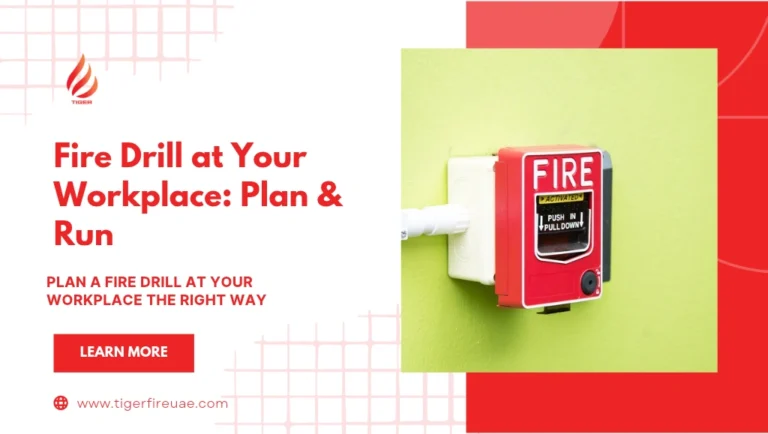
- Start the alarm. Sound the fire alarm using the manual call point or the test function agreed with your fire alarm company.
- Leave straight away. Staff stop work, leave belongings behind and walk, not run, to the nearest safe exit.
- Wardens check their areas. They look in rooms, meeting areas and toilets, close doors behind them and guide everyone out.
- Help those who need it. Assistants help any person who cannot use the stairs alone.
- Gather at the assembly point. Everyone goes to the agreed place and stays there.
- Take a headcount. Wardens count their groups and report to the person in charge. Visitors and contractors must be counted too.
- Note the time. Record when the alarm started, when the building was clear and when the last person reached the assembly point.
- Give the all clear. Only the person in charge decides when people can go back inside.
During the drill, have one or two observers watch quietly. They should write down what works and what does not, such as people going back for their phones, crowding at one door or ignoring the alarm.
Step 4: Review and Improve
The most useful part of the drill comes after it. Hold a short meeting the same day or the next morning while everyone still remembers what happened.
Ask simple questions:
- Did everyone hear the alarm in every area?
- Did people use the right exits?
- Was any exit or corridor blocked?
- How long did it take to clear the building?
- Did wardens know what to do?
- Did anyone need help that we had not planned for?
Write a short report with the date, time, number of people, results and a list of actions with names and deadlines. Keep these reports in a file. They show Civil Defense and your insurer that safety is part of how you work.
Conclusion
A well-planned fire drill at your workplace does not need to be complicated. Set a clear goal, train your wardens, run the drill in a calm and simple way, and always review the results. Each drill makes your team faster and more confident, and that confidence can save lives.
Tiger Fire is an ISO certified fire protection company in Mussafah, Abu Dhabi. We can test your fire alarm and detection systems before your drill and keep them in good order all year. Call 02 56 20222 or +971 54 9993841, or email sales@tigerfireuae.com to plan your next fire safety check.