
Introduction
Fire safety is a fundamental requirement for every building, whether it is a family home, apartment complex, office tower, retail store, warehouse, or industrial facility. However, not all fire protection systems are designed the same way. The fire risks, occupancy levels, building structures, and regulatory requirements differ significantly between residential and commercial properties.
Understanding the differences between Residential vs Commercial Fire Protection Systems Abu Dhabi is essential for property owners, facility managers, developers, and business operators. Choosing the right fire protection solution not only helps protect lives and assets but also ensures compliance with local fire safety standards and building regulations.
In Abu Dhabi’s rapidly expanding residential and commercial sectors, modern fire protection systems play a critical role in reducing fire risks and improving emergency response capabilities. This guide explores the key differences between residential and commercial fire protection systems and explains how property owners can select the most suitable solution for their specific needs.
Why Fire Protection Systems Matter in Abu Dhabi
Abu Dhabi is home to a diverse range of properties, from luxury villas and residential towers to shopping malls, hospitals, warehouses, and industrial complexes. Each type of building faces unique fire risks that require specialized protection measures.
A well-designed fire protection system can detect fires early, alert occupants, support safe evacuation, and assist emergency responders in controlling the incident before it escalates. Without proper fire protection, even a small fire can cause significant property damage, business disruption, injuries, or loss of life.
Benefits of Effective Fire Protection Systems
- Early fire detection
- Faster emergency response
- Enhanced occupant safety
- Reduced property damage
- Improved regulatory compliance
- Better business continuity
Whether residential or commercial, every building requires a fire protection strategy tailored to its risk profile.
Understanding Residential Fire Protection Systems
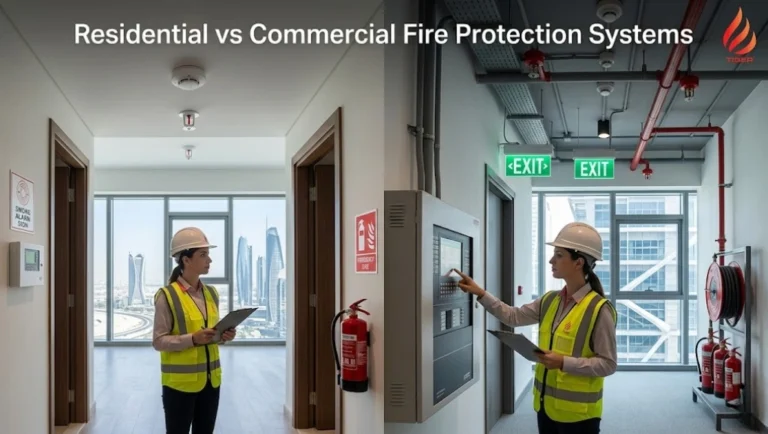
Residential fire protection systems are designed primarily to safeguard occupants within homes, apartments, villas, and residential communities.
These systems focus on providing early warning and supporting safe evacuation during emergencies. Residential properties generally have lower occupancy levels and fewer fire hazards compared to commercial facilities.
Common Residential Fire Protection Components
- Smoke detectors
- Heat detectors
- Fire extinguishers
- Residential sprinkler systems
- Emergency lighting
- Fire alarm systems
The primary objective is to provide sufficient time for residents to evacuate safely while minimizing fire spread.
Understanding Commercial Fire Protection Systems
Commercial properties typically face more complex fire risks due to higher occupancy levels, specialized equipment, storage areas, and operational activities.
Commercial fire protection systems are designed to manage larger-scale emergencies and protect both occupants and valuable business assets.
Common Commercial Fire Protection Components
- Addressable fire alarm systems
- Automatic sprinkler systems
- Fire pumps
- Fire hydrants
- Smoke control systems
- Emergency communication systems
- Specialized suppression systems
Commercial facilities often require multiple layers of protection to address varying fire hazards throughout the building.
Difference #1: Building Occupancy and Risk Levels
One of the most significant differences in Residential vs Commercial Fire Protection Systems Abu Dhabi is the occupancy level and associated fire risk.
Residential buildings generally contain fewer occupants and predictable usage patterns. Fire risks are commonly associated with cooking, electrical appliances, and household equipment.
Commercial properties may accommodate hundreds or even thousands of occupants daily. Additionally, businesses often contain electrical systems, machinery, inventory, chemicals, and operational processes that increase fire risk.
Residential Risks
- Kitchen fires
- Electrical faults
- Heating equipment
- Household appliances
Commercial Risks
- Equipment failures
- Industrial processes
- Chemical storage
- High occupant density
- Data and technology infrastructure
As risk levels increase, fire protection systems become more sophisticated.
Difference #2: Fire Alarm System Complexity
Residential fire alarm systems are typically simpler than those used in commercial buildings.
A residential fire alarm system may include smoke detectors connected to a local control panel or standalone alarms throughout the property.
Commercial facilities often use addressable fire alarm systems capable of identifying the precise location of an alarm. These systems provide detailed information that helps emergency responders react more efficiently.
Commercial Alarm Features
- Zone identification
- Central monitoring
- Integrated emergency notifications
- Building-wide communication
- Remote management capabilities
The complexity of commercial fire alarm systems reflects the larger scale and higher risks involved.
Difference #3: Fire Suppression Requirements
Fire suppression is another major area where residential and commercial systems differ significantly.
Residential properties may utilize portable fire extinguishers and, in some cases, residential sprinkler systems. These systems are designed to control fires until emergency services arrive.
Commercial properties often require more advanced suppression technologies.
Commercial Fire Suppression Systems
- Automatic sprinklers
- Foam suppression systems
- Clean agent systems
- Kitchen suppression systems
- Water mist systems
The type of suppression system depends on the specific hazards present within the facility.
Choosing the Right Fire Protection System for Your Property
Selecting the appropriate system requires a thorough assessment of the property’s characteristics, occupancy levels, and fire hazards.
Property owners should consider:
Key Factors
- Building size
- Occupancy type
- Fire risks
- Business operations
- Asset value
- Emergency evacuation requirements
Residential properties generally require simpler protection measures, while commercial facilities often need comprehensive, integrated fire safety solutions.
Working with experienced fire protection professionals can help ensure that systems are designed and installed according to the property’s specific requirements.
Conclusion
Understanding Residential vs Commercial Fire Protection Systems Abu Dhabi is essential for property owners seeking effective fire safety solutions. While residential systems focus primarily on occupant protection and early warning, commercial systems are designed to address more complex risks, larger occupancies, and valuable business assets.
The differences in fire alarm systems, suppression technologies, water supply requirements, maintenance procedures, and overall system complexity highlight the need for tailored fire protection strategies. By selecting the right fire protection system and maintaining it properly, property owners can improve safety, reduce risks, and ensure compliance with fire safety standards in Abu Dhabi.
Whether protecting a family home or a large commercial facility, investing in the appropriate fire protection system remains one of the most important decisions any property owner can make.